All You Need to Know About Projector Screen Paint

All You Need to Know About Projector Screen Paint
All You Need to Know About Projector Screen Paint

  1. Introduction
  2. What is Projector Screen Paint?
  3. What Are The Types of Projector Screen Paint?
  4. What Are The Features Of Projector Screen Paint?
  5. What Are The Benefits of Using Projector Screen Paint?
  6. What Is The Use Of Projector Screen Paint?
  7. Key Takeaway

Benefits of Projector Screen Paint for Walls

Benefits of Projector Screen

Projector screen paint is engineered to absorb as little light as possible and, crucially, to reflect light back in a controlled direction rather than scattering it everywhere. The result is that more light reaches your eyes instead of bouncing uselessly around the room, which translates directly to a brighter, more vivid image.

Think of it like the difference between shining a torch at a brick wall versus a road sign. The brick wall scatters light in all directions and looks fairly dull. The road sign sends light back towards you, appearing much brighter from your viewing position. Projector screen paint is similar to the road sign effect. 

Let’s read and understand about: what is projector screen paint, the types of projector screen paint, features of projector screen paint, and benefits of using projector screen paint.

What is Projector Screen Paint?

The answer to this question: What is Projector Screen Paint? is that, the paint has reflective properties designed to bounce light back to your eyes more effectively.

Standard white paint absorbs a bit of light and scatters it randomly. Projector screen paint contains tiny reflective particles (usually microscopic glass beads or similar materials) that redirect light back towards the viewer.

What Are The Types Of Projector Screen Paint?
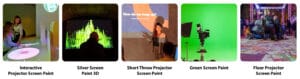
Types Of Projector Screen Paint

Types Of Projector Screen Paint


There are various types of projector screen paint. There's also a proper reasoning behind having this many options. Let’s learn about projector screen paint types.

1. Ambient Light Rejecting Projector Screen Paint 

Ambient Light Rejecting Projector Screen Paint or ALR Screen Paint, tackles one of the biggest problems with home projectors – watching anything during the day. 

It's designed to reject light from windows and ceiling fixtures while allowing the projector's light to pass through. This means you can watch films without closing every curtain in the house. 

The technology uses specially angled particles that bounce projector light back to you but absorb ambient light from other directions. It is best suited for places with moderate light control.

2. Black Projector Screen Paint

Black Projector Paint for a projector screen is designed for situations where you cannot control ambient light, such as conference rooms or commercial spaces. 

The black surface absorbs stray light brilliantly, giving you genuinely deep blacks and impressive contrast. For this you'll need minimum 2500 lumens from your projector to compensate for the light absorption. 

3. Clear Projector Screen Paint

Clear Projector Screen Paint has a clever technology that lets you turn windows or glass partitions into projection surfaces while maintaining transparency during the day. The paint works from either side, so you can project from inside for outdoor viewing or vice versa.

Ideal for classroom, office, gaming, and home theatre, it guarantees precise image projection and the best possible viewing experience in normal to low ambient lighting.

4. High Contrast Projector Screen Paint

High Contrast Projector Screen Paint is like a middle ground between standard white paint and extreme black options. 

This paint provides better blacks and more vibrant colours than basic projector paint. In contrast to ordinary material surfaces, it keeps performance steady throughout time and avoids hotspotting.

It also provides a better home theatre or gaming experience by enhancing contrast levels and keeping the screen black.

5. Outdoor Projector Screen Paint 

Standard projector paint deteriorates outdoors within months – moisture seeps in, UV light breaks down the reflective properties, and you're left with a patchy disaster. 

The Outdoor Projector Screen Paint formula resists moisture, handles temperature fluctuations, and won't fade in sunlight, making it suitable for painting on exterior walls, sheds, or purpose-built outdoor screens. 

It is designed to provide bright, sharp images day and night by optimising light return in both low and high ambient light settings. It is also adaptable to different projectors and offers a variety of projector options, such as normal, short throw, HD, 4K, interactive, and ultra-short throw projectors.

6. Interactive Projector Screen Paint

Interactive Projector Screen Paint works with interactive projectors – the ones that turn your projection surface into a giant touchscreen. The paint's formulation allows the infrared sensors in interactive projectors to detect touch accurately, which standard projector paint doesn't do reliably. 

The answer to the question, what is the use of Projector Screen Paint. Is that it is used in workplaces, meeting spaces, and classrooms where numerous people can regularly interact. 

7. Silver Screen Paint 3D

Silver Screen Paint delivers impressive brightness. Prevents projection hotspots for uniform image quality. Achieve ideal images free from hot spots and performance hiccups with Smarter Surfaces product. 

The paint helps to create 3D havens in places like galleries, museums, movie theatres, and home theatres. Powerful 3D equipment and low to medium ambient light levels are ideal for this paint.

8. Short Throw Projector Screen Paint

Short throw projectors are designed to create interactive projection surfaces that are perfect for collaborative and immersive learning environments. It is a great option for businesses, conference rooms, and classrooms with moderate to high ambient light levels because it works flawlessly with both short throw and ultra-short throw projectors. 

To ensure that the projected 3D images are shown with perfect accuracy and immersion, our Smarter Surfaces Short Throw Projector Screen Paint is specially designed to maintain light polarity.

9. Green Screen Paint

If you're creating YouTube videos, streaming, or doing any sort of content creation, this paint solves the eternal green screen problem without the wrinkles and storage hassles of fabric. Simply paint a wall (or two walls if you want corner flexibility) with this properly calibrated green, and you've got a permanent chroma key backdrop ready whenever you need it. 

Holocrystalline crystals and organic coloured pigments are used in Smarter Surfaces Green Screen Paint to create a consistent matte finish that is sheen-free.

10. Floor Projector Screen Paint

Floor Projector Screen Paint turns floors into projection screens that can withstand foot traffic. The paint requires high-definition projectors for events, stores, and public spaces to captivate crowds. It is intended for projectors rated at least 2,500 lumens.

Bright, sharp, high-definition images are reflected by high-performance projectors in ambient light.

What are the Features of Projector Screen Paint?

Projector screen paint has technical features that differentiate it from ordinary paint: controlled reflectivity, colour neutrality, smooth finish, and varying degrees of ambient light management. 

Let's learn about projector screen paint and talk what actually makes projector screen paint different from normal paint. 

1. Reflective Properties

The main features of projector screen paint and the reason projector paint exists – is how it handles light. Ordinary emulsion absorbs a fair amount of light your projector throws at it and scatters the rest randomly. Projector screen paint contains microscopic reflective particles (usually glass beads or similar materials) that bounce light back towards the viewer rather than dispersing it uselessly across the room.

The reflective coating means you're getting more of the projector's light output actually reaching your eyes. This means a more vivid image.

2. Gain Ratings

Gain ratings are a measurement of how much light the surface reflects compared to a standard reference white. A gain of 1.0 means it reflects light like standard white paint. A gain of 1.5 reflects 50% more light. 

Most decent projector paints sit somewhere between 0.9 and 1.2 gain, which provides improved brightness without creating viewing angle nightmares. Going higher than that requires understanding the trade-offs you're accepting.

3. Colour Accuracy and Neutrality

Proper projector screen paint maintains colour neutrality. This means it doesn't add its own colour cast to the projected image.

Professional projector paints are formulated to have a neutral colour temperature, which matches the standard for video content.

Grey and black projector paints are designed to maintain accurate colour reproduction while improving contrast. The grey absorbs ambient light without the colours your projector produces.

4. Smooth, Non-Textured Finish

Texture is the enemy of projected images. Any bumps, ridges, or rough patches on the wall will show up as imperfections in the picture.

Quality projector screen paint is formulated to create a smooth finish. Some products include levelling agents that help the paint settle evenly without visible brush or roller marks.

 5. Durability and Washability

Projector screen paint needs to last. You're not repainting every couple of years like with ordinary walls. Smarter Surfaces quality projector paints are designed to be durable and cleanable without losing their reflective properties.

That means you can wipe off the inevitable fingerprints, dust, or mysterious marks that appear on walls without degrading the paint's performance. 

6. Low VOC and Environmental Considerations

Smarter Surfaces safe and eco-friendly projector screen paints are low-VOC (volatile organic compounds) or zero-VOC. This means they don't release nasty chemicals into your home as they dry. 

These paints are environment friendly with responsible formulations. This isn't just better for the environment – it means you can actually use the room fairly quickly after painting without feeling like you're huffing paint fumes.

7. Coverage and Application Requirements

Safe and eco-friendly projector screen paints often have different coverage rates than standard emulsion. Some products are quite thick and cover well in two coats. Others require three or even four coats to achieve the specified reflective properties.

The application method matters too. Some paints work fine with a standard roller, whilst others perform best when sprayed. A few are genuinely fussy about application technique.

8. Ambient Light Management

These features of projector screen paint vary depending on which type of projector paint you choose. 

  • Standard white paint doesn't actively manage ambient light – it just reflects what hits it. 
  • Grey paint passively helps by absorbing some ambient light. 
  • ALR (ambient light rejecting) paint actively rejects off-axis light while accepting the projector's light.

The effectiveness of ambient light management determines where you can realistically use the paint. Standard white paint needs proper darkness. Grey paint handles moderate ambient light reasonably well. ALR paint can cope with significantly brighter conditions, though it's not magic – trying to watch in full daylight still won't deliver great results.

Understanding how much ambient light management you need prevents disappointment.

9. Compatibility with Different Projector Types

When you learn about projector screen paints, you notice that most projector paints work with standard throw projectors, but some are specifically formulated for particular setups. 

Short throw projector paint, for instance, handles the acute angles that occur when the projector sits close to the wall. Interactive projector paint works with the infrared sensors that detect touch.

Standard projector paint won't necessarily perform well with every projector type. If you've got a 4K HDR projector capable of high brightness, you want paint that can handle that without washing out. If you're using an ultra-short throw projector, you need paint designed for the specific light angles involved.

Checking compatibility before committing to a particular paint prevents expensive mistakes.

What Are The Benefits of Using Projector Screen Paint?

Benefits of Using Projector Screen Paint?

Let's talk about the actual benefits of using projector screen paint. Some of these are genuinely significant, while others matter more depending on your specific situation.

1. No Bulky Equipment

The most obvious benefits of using projector screen paint is visual simplicity. It has no massive frame dominating your wall, no bulky housing hanging from the ceiling, just a normal-looking wall when the projector's off. 

This matters in living rooms or multipurpose spaces that need to function as regular rooms most of the time, rather than screaming "dedicated cinema" constantly. 

Your setup remains completely invisible until you actually fire up the projector, which keeps the room feeling like a proper living space rather than a tech showroom.

2. Cost Savings

Here's where projector paint makes serious financial sense. A decent quality 100-inch pull-down screen costs £300-600. Quality projector screen paint covering the same area costs £100-250, including primer and supplies.

When you learn about projector screen paint, you know that savings become more dramatic as screen size increases. The paint to cover a large area costs essentially the same as covering 100 inches; you're just painting a bigger section of wall.

3. Customisable Size and Shape

You're not constrained by standard screen dimensions like 100", 120", or 135". Paint exactly the size and aspect ratio that fits your wall perfectly, whether that's 118 inches wide or an unusual cinemascope format.

This flexibility is particularly useful for awkward spaces with alcoves, architectural features, or non-standard proportions where finding a commercial screen in the right dimensions means expensive custom fabrication. Want to work around picture rails, fit an irregular wall, or create an unusually wide format? Just paint the exact shape you need.

4. Superior Ambient Light Performance

ALR projector paint handles ambient light better than standard white screens and often performs comparably to ALR fabric screens, costing several times more. The difference is particularly noticeable in living rooms or spaces where you can't achieve complete darkness with maintained contrast and colour saturation. 

Grey and black formulas deliver contrast improvements that mid-range white screens simply can't match, making viewing acceptable in conditions that would otherwise be hopeless.

5. Zero Maintenance and Nothing to Break

Projector screens have motors, springs, tensioning systems, and fabric – all components that eventually fail, requiring repairs or replacement. 

Paint just sits on your wall indefinitely with zero maintenance beyond occasional gentle cleaning, no mechanical parts to service, no fabric to replace, and no motors burning out after a few years. 

The reliability difference is genuinely significant when you consider friends' expensive motorised screens developing issues whilst painted walls continue performing consistently year after year.

6. Easier Installation

Installing a large fixed-frame screen means mounting a weight perfectly level on your wall.

One of the most convenient benefits of using projector paint is its straightforward DIY skills. This includes filling, sanding, priming, and painting – without specialised tools, heavy lifting, or drilling multiple mounting holes. 

7. Perfect for Awkward Spaces

Some rooms don't accommodate traditional screens well. Low ceilings make pull-down screens impractical. Irregular walls make fixed frames difficult. Architectural features get in the way. Paint works around these limitations because you're working with the wall itself rather than mounting something to it.

The flexibility of simply painting whatever surface works for your space solves problems that would be genuinely difficult or impossible with conventional screens.

8. Improved Image Quality

With the right paint for your conditions, image quality often surpasses budget and mid-range screens. Grey paint delivers better contrast than standard white screens in rooms with ambient light. ALR paint outperforms non-ALR screens in bright conditions. High-contrast formulas rival expensive specialty screens.

The improvement is noticeable when moving from a basic white screen to grey or high-contrast paint in less-than-ideal lighting situations. Same projector, noticeably better blacks, more saturated colours, improved overall depth – genuine performance gains at lower cost. 

9. No Frame Shadows or Visual Distractions

A painted wall has no frame, no edges, no borders, casting shadows or reflecting light. The projected image appears to float on the wall without visual interruptions. This sounds like a minor detail, but many people find it better, which improves the viewing experience. You're immersed in the image rather than constantly aware of the screen's physical presence.

In properly dark rooms during atmospheric films, the lack of a visible frame creates a more cinematic experience. The image edges blend into darkness rather than being defined by a bright frame border.

10. Future-Proofing Your Setup

Paint offers flexibility in screen format. Simply repaint a different area in a new aspect ratio if preferences change, or adjust paint type if you upgrade to a brighter projector requiring different characteristics. 

If you move house, you're not transporting massive screens; you just paint the new space. The flexibility means your projection surface can adapt as your needs evolve rather than being locked into decisions made years ago.

What is the Use of Projector Screen Paint?

Projector screen paint is useful when you want a permanent, integrated projection surface that doesn't dominate your space with equipment. It's valuable for dealing with ambient light, creating large-format displays without bulky hardware, or situations where traditional screens are impractical.

Below are some known spaces where projector paints are used. These spaces are the best use cases, but are not limited to your imagination.

  • Home Cinema
  • Garden Cinema
  • Business Presentations 
  • Schools and Interactive Learning
  • Content Creation

Key Takeaway

About Projector Screen Paint, it has come a long way from being a niche product to a practical solution for home cinema enthusiasts and professionals alike. Whether you're dealing with awkward ambient light, limited space, or simply want a cleaner aesthetic than bulky screens provide, there's paint that fits your situation. 

That said, it's not a magic fix for every projection problem – you still need decent wall preparation, a capable projector, and realistic expectations about what paint can achieve. The key is matching the right type of paint to your specific circumstances. Grey paint for moderate ambient light, ALR for trickier conditions, standard white for properly dark rooms – each has its place. 

Projector screen paint delivers results that genuinely rival traditional screens at a fraction of the amount and often the cost.

Best Silver Screen Paint for 3D projection: A Complete Buyer’s Guide

Best Silver Screen Paint for 3D projection: A Complete Buyer’s Guide

Best Silver Screen Paint for 3D projection

  1. Introduction
  2. What is Silver Screen Paint?
  3. Evaluation Process For Best Silver Screen Paint For Projector
  4. Benefits of Best Silver Screen Paint for 3D Projection
  5. Key Takeaway
  6. FAQs

Creating the perfect home cinema experience has become increasingly popular amongst UK homeowners, with the best Silver Screen Paint for 3D Projection technology leading the charge. However, achieving professional-quality results requires more than just an expensive projector – the screen surface plays an equally crucial role.  Silver screen projector paint has emerged as a game-changing solution, offering superior brightness and contrast compared to traditional white screens while maintaining excellent 3D performance.

What is Silver Screen Paint?

What is Silver Screen Paint?

Silver screen paint contains microscopic metallic particles that reflect light more efficiently than conventional white surfaces. This technology dates back to early cinema houses, where silver-coated screens were standard. Modern formulations have refined this concept, creating paints specifically engineered for home projection systems.

Smarter Surfaces Silver Screen Projector Paint is a 3D projector paint that turns any wall or smooth surface into an ultimate 3D projection screen. Not just high-end home theatres, this specialised paint is ideal for commercial spaces like movie halls, museums, galleries, and event arenas as well.

What makes it stand out is its ability to reflect a remarkably high percentage of the projected light. This higher light reflection eliminates any loss in picture quality, even in environments with low to medium ambient light. As a result, you get brighter and cleaner images with high depth and clarity.

Our silver high-gain projector paint can be applied to any wall or smooth surface. You can even use it over old fabric screens to refurbish them. However, it’s not suitable for roll-up screens.

Now that we have a clear idea about the paint and what it does, here’s a lowdown on the key benefits that make it the best choice for high-definition 3D projection.

Evaluation Process For Best Silver Screen Paint For Projector

Evaluation Process For Best Silver Screen Paint For Projector

The ideal and best silver screen paint for a projector balances multiple factors: 3D performance, colour accuracy, viewing angle requirements, and budget considerations. This section will talk about selecting and applying silver screen paint effectively.

Step 1: Assess Your Room Conditions

Before selecting any silver projection paint for home theatre, thoroughly evaluate the viewing environment. Measure ambient light levels during typical viewing times. Silver screens perform well in controlled lighting but can appear overly bright in rooms with significant ambient light.

Consider the size of the room and the sitting position. Silver screens have good brightness but with limited viewing ranges compared to white screens. Make sure that all seating positions are inside the best viewing area (usually 45 degrees of the centre).

Document wall texture and condition. Silver screen paints require smooth, properly prepared surfaces for optimal performance. Textured walls may require additional preparation work.

Step 2: Determine Your Projector Compatibility

Not all projectors work equally well with silver screens. Check your projector’s specifications for light output (measured in lumens) and colour temperature. Silver screens with the best projector screen paint for 3D amplify brightness, so lower-lumen projectors often benefit significantly from the increased gain.

Verify 3D capability and polarisation method. Passive 3D systems using polarised glasses work exceptionally well with silver screens. Active 3D systems may not see the same benefits but still perform adequately.

Test colour accuracy if possible. Some users report that silver screens can introduce a slight cool colour cast. Modern formulations have largely addressed this issue, but testing remains advisable.

Step 3: Calculate Required Coverage Area

Measure your intended screen area precisely. Most silver screen paints cover approximately 15-20 square metres per litre, though coverage varies by surface texture and application method.

Consider screen shape requirements. Standard rectangular screens are straightforward, but curved or custom shapes may require additional planning and masking techniques.

Step 4: Research Available Products

Several providers produce quality 3D projector screens but for paint there are only a small number technically capable of producing paint for 3D. For example, Smarter Surfaces is known for what is arguably the best silver screen paint for projector specifically targets 3D projection applications. 

The formulation includes advanced metallic particles designed to preserve polarisation whilst minimising hot-spotting. Their silver variants provide excellent 3D performance with good colour accuracy.

Step 5: Evaluate Gain Specifications

Screen gain measures how much light the surface reflects compared to a standard white screen. Silver screen paints typically offer gains between 1.2 and 2.8.

Higher gain values provide brighter images but create narrower viewing angles and potential hot-spotting (bright spots visible from certain angles). For most home applications, gains between 1.4 and 1.8 provide the best balance.

Consider your projector’s brightness when selecting gain. Dim projectors benefit from higher gains, whilst very bright projectors may require lower gains to avoid overwhelming the image.

Step 6: Plan Surface Preparation

Proper surface preparation determines final quality more than paint choice. Start with a completely clean, smooth wall surface.

Fill any holes, cracks, or imperfections with appropriate filler. Sand smooth once dry. Even minor surface irregularities become magnified when projected upon.

Apply a high-quality primer designed for the specific paint system. Many silver screen paints require specific primers to achieve optimal performance and adhesion.

Allow adequate drying time between preparation steps. Rushing this process often leads to disappointing results that require complete re-application.

Step 7: Select Application Method

Best Silver Screen Paint for 3D projection can be applied using brushes, rollers, or spray systems. Each method offers distinct advantages and challenges.

Brush application provides excellent control but may leave texture marks. Use high-quality synthetic brushes designed for water-based paints.

Roller application covers large areas quickly and evenly. Choose rollers with minimal texture – foam rollers often work well for silver screen paints.

Spray application delivers the smoothest finish but requires proper equipment and technique. Consider a professional application for spray methods unless experienced with spray painting.

Step 8: Execute Proper Application Technique

Begin application during optimal environmental conditions – low humidity, moderate temperatures, and minimal air movement.

Apply thin, even coats rather than attempting to achieve full coverage in one pass. Most silver screen paints require 2-3 coats for optimal performance.

Maintain wet edges to avoid lap marks. Work systematically across the surface without stopping mid-section.

Ensure a commercial paint sprayer is used that atomises the paint, small handheld DIY paint sprayers are not suitable.

Allow proper drying time between coats as specified by manufacturer’s instructions. Inadequate drying can cause adhesion problems and uneven appearance.

Step 9: Quality Control and Testing

Inspect the finished surface under proper lighting before projector testing. Look for streaks, uneven coverage, or texture issues that may affect projection quality.

Set up your projector and test with various content types. Check 3D performance specifically, looking for ghosting or reduced stereoscopic effect.

Evaluate colour accuracy using test patterns or familiar content. Make note of any colour shifts that may require projector adjustment.

Test viewing angles from all seating positions. Ensure acceptable image quality throughout your intended viewing area.

Step 10: Final Adjustments and Optimisation

Adjust the projector as per your silver screen. This can involve brightness, contrast and colour temperature.

Include lighting adjustments in the rooms to optimise the performance of the screens. Perceived image quality can be substantially enhanced even by small reduction of ambient light.

Record your settings and paint specifications in case you will need them in the future. This data is useful in maintenance or troubleshooting.

Ready to upgrade your experience? Shop Smarter Surfaces’ top-rated products today.

[siteorigin_widget class=”SiteOrigin_Widget_Image_Widget”][/siteorigin_widget]
[siteorigin_widget class=”SiteOrigin_Widget_Button_Widget”][/siteorigin_widget]
[siteorigin_widget class=”SiteOrigin_Widget_Image_Widget”][/siteorigin_widget]
[siteorigin_widget class=”SiteOrigin_Widget_Button_Widget”][/siteorigin_widget]
[siteorigin_widget class=”SiteOrigin_Widget_Image_Widget”][/siteorigin_widget]
[siteorigin_widget class=”SiteOrigin_Widget_Button_Widget”][/siteorigin_widget]

Benefits of Best Silver Screen Paint for 3D Projection

Benefits of Best Silver Screen Paint for 3D Projection

The benefits of silver screen paint below make 3D projection screen paint an attractive option for home cinema enthusiasts, particularly those prioritising 3D content and maximum image quality within their specific viewing environment.

  • Enhanced Brightness and Image Quality

Silver screen projector paint increases picture brightness as compared to standard white screens. Light is reflected more efficiently by the metallic particles. This makes it suitable for spaces with some ambient lighting or with projectors of lower lumen output.

  • Superior 3D Performance

The primary advantage of 3D projection is that the paint maintains light polarisation. Traditional white screens tend to depolarise light from 3D projectors, resulting in ghosting and reduced stereoscopic quality. Silver screens preserve the polarised light that is required to produce clear, sharp 3D images with minimal crosstalk between left and right eye images.

  • Improved Contrast Ratios

Silver screen paint enhances contrast by reflecting more light to viewers while maintaining deep blacks. This creates more vivid, punchy images with better definition between light and dark areas. The increased contrast is particularly noticeable in darker viewing environments.

  • Cost-Effective Solution

Compared to purchasing a large commercial projection screen, silver screen paint offers excellent value. A typical application costs a fraction of what a quality-manufactured screen would cost, often delivering comparable or superior performance for the specific viewing environment.

  • Customisable Screen Sizes

Paint allows for completely custom screen dimensions and shapes. Whether creating an ultra-wide cinema format, curved screen, or unusual aspect ratio, paint adapts to any surface configuration. This flexibility is impossible with pre-manufactured screens.

  • Seamless Integration

Smarter Surfaces best projector screen paint for 3D, when used correctly, forms a flush, built-in look that does not stick out of the wall. This gives it a cleaner look than mounted screens, especially in multi-purpose rooms or areas where the screen may not be used all the time.

  • Reduced Hotspotting

Quality silver screen paints are formulated to minimise hotspotting – bright spots that can appear with high-gain surfaces. Modern formulations distribute light more evenly across the viewing area compared to older silver screen technologies.

  • Long-Term Durability

When properly used, the Best Silver Screen Paint for 3D projection can last for 5-10 years with minimal maintenance. Compared to fabric screens that will sag, wrinkle, or get dirty, painted surfaces remain always flat and are simpler to clean as desired.

  • Space Efficiency

Paint eliminates the need for screen mounting hardware, motorised systems, or storage space for retractable screens. This is particularly beneficial in smaller rooms where every centimetre counts.

  • Professional Results at Home

Silver screen paint can deliver cinema-quality results in domestic settings, particularly when combined with appropriate room design and lighting control. Many commercial cinemas historically used silver screens for their superior performance characteristics.

Key Takeaway

The ideal and the best Silver Screen Paint for 3D projection balances multiple factors: 3D performance, colour accuracy, viewing angle requirements, and budget considerations. Premium products justify their cost through superior performance and longevity, whilst budget options can still deliver satisfactory results for less critical applications.

The best silver screen paint is the one that works optimally with your specific equipment and room conditions. Take time to research thoroughly, prepare properly, and apply carefully – the results will reward your patience with years of exceptional 3D projection performance.

[siteorigin_widget class=”WP_Widget_Custom_HTML”][/siteorigin_widget]
Engage and Entertain: Upgrade your Hospitality Venue with Projection Screen Wall Paint

Engage and Entertain: Upgrade your Hospitality Venue with Projection Screen Wall Paint

In a competitive hospitality market, creating a lasting positive impression on your guests is vital in order to stand out. While good food and quality service will always be the cornerstone, adding a wow factor to your decor with a large dynamic canvas for games, presentations, or just promotion can take it up a notch.

Projection screen wall paint is a stylish and cost-effective way to transform any smooth surface into a high-end screen. It is a one-of-a-kind solution to engage and entertain your guests while ensuring that your venue stands out.

In this blog, we will delve into the details of how Michelin Star restaurants and elite hotels to local cafes can use projector wall paint to upgrade. But, first, let’s take a quick look at the advantages it offers.

projection screen paint for hospitality

What are the advantages of using projection screen wall paint in hospitality venues?

Prominent hospitality establishments like Doubletree by Hilton, Hotel Federico Italy, Novotel, Swissotel Berlin, and many others are already using our projection screen wall paint solutions. Here’s why these front-runners are choosing our projection paints over traditional screens.

Traditional screens have their benefits but they come with limitations that can hinder the overall experience. Projector wall paint eliminates these limitations and makes your venue more engaging.

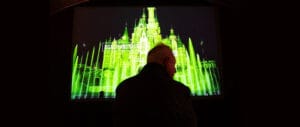
  • Maximum flexibility: Turn any wall, furniture, or even the whole room into a captivating screen without wasting space to accommodate a screen and accessories. Plaster, wood, wallboards, concrete, metal, or composite — our projector screen paints work on any smooth surface. This flexibility allows for innovative uses, such as transforming ceilings into starry night skies or floors into interactive gaming zones.
  • Integrates seamlessly: Projection screen wall paint seamlessly transforms your existing wall or furniture into a screen without altering the aesthetics of the place. They are ideal for minimalistic, smart, and modern setups.
  • Customisable in size: Unlike fixed-size screens, projection paint allows for complete customisation. You can utilise an entire wall, table, or a designated portion, creating a truly immersive viewing experience that perfectly complements your venue’s layout. For example, a full-wall sports screen in a bar or a thematic display in a hotel’s lobby can quickly uplift the space.
  • Works in ambient light: Our Short throw projector screen paint is designed to deliver high-quality output even in rooms with moderate to high ambient light. So, even if your venue has a brighter theme, these paints ensure that the colours appear vibrant and not washed out. They make an excellent choice for bright cafes or open-concept hotel lobbies where there is a lot of natural light.
  • Cost-effective: Compared to purchasing and installing traditional screens, projection screen paint offers a cost-effective alternative. The paint itself is relatively inexpensive, and installation requires minimal effort compared to mounting bulky screens.
  • Easy to maintain: To top it all, projector wall paint screens are simple to maintain. Just wipe them down with a soft damp cloth. That’s all the maintenance they need. Our projector wall paints don’t yellow over time and come with a 5-year guarantee.

How hospitality venues can utilise projection screen wall paint?

Projection wall paint unlocks a world of possibilities for hospitality venues to engage and entertain guests. Here’s how different establishments can leverage this innovative solution.

Restaurants:

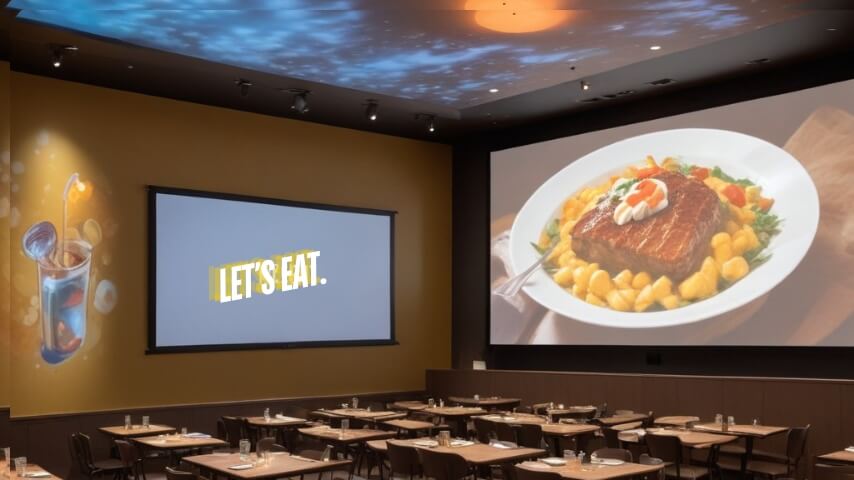
  • Project dynamic menus and promotions: Project menus right on the wall and update them in real time. Showcase dishes with high-quality visuals, and integrate nutritional information to make it more appealing. Play videos on ingredient sourcing on the large wall screen to add a new dimension to the dining experience.
  • Highlight daily specials and food prep: Showcase your daily specials on the large projection painted restaurant wall along with relevant information snippets. It’s a simple way to inform and attract guests. Captivate with live food preparation streams or recorded videos right from your kitchen.
  • Craft immersive dining experiences: Project themed visuals or video loops to match your restaurant’s ambience. Transform a potentially dull waiting area into an engaging space by projecting informative content, or themed videos right on the wall or partition.

Cafes:

  • Craft lively entertainment: Liven up the cafe atmosphere by projecting live music performances and popular comedy shows on the large painted screen. Gaming projection screen wall paints work seamlessly with all latest game consoles. These are ideal if you want to leverage gaming as a special attraction in your cafe.
  • Add a theme: Give your cafe a new theme every week or season. With projection wall paint, you can change the ambience as frequently as you wish without much hassle. Transform your cafe into a mini-art gallery by displaying digital art pieces or take your guests on a trip to the snowy mountains during hot summers.
  • Boost sports viewing: Turn your cafe into the go-to spot for game-watching by projecting live matches on a large, immersive wall display. It is an effective way to bring more people to your cafe and turn it into a popular meeting spot for the locals.

Hotels:

  • Captivating presentations: Meeting rooms and conference halls can now say goodbye to bulky screens. Our projector screen paint pro not only allows for crisp presentations with clear visuals, even in large spaces but also gives the opportunity to turn any wall or furniture into an immersive screen without any size limitations. To make your meeting rooms stand out, you can also use the Magnetic projector screen whiteboard wallpaper. It will let you write and stick papers right on the projection screen, giving every meeting and presentation an interactive edge.
  • Design guest experiences: Create a digital welcome message board in your lobby or the rooms. It can display greetings and vital information like local weather forecasts. Use the same space for playing visuals that create a pleasant ambience according to your establishment’s theme.
  • Promote local attractions: Showcase the best of your city or region by projecting images and information about nearby attractions, directly in the lobby or common areas. Display transport details, city maps, and important local authority numbers to ensure that your guests have all the vital information for a pleasant experience.

Make Smarter Surfaces Your Partner for Premium Projection Screen Wall Paints

Smarter Surfaces, a global leader in projector wall paint, boasts an extensive range of projection paints designed to meet the different needs of hospitality establishments of every size and shape.

If you’re looking for a projector paint that will deliver excellent projection results in meeting rooms and conference halls, here are some options to consider.

Short Throw Projector Screen Paint

This paint is designed particularly for use with short throw projectors up to 4K Ultra HD in moderate to high ambient light setups. It eliminates hotspots and delivers a high-quality experience in meeting rooms. This smart white short throw projector screen paint with a matte finish is suitable for use on plaster, wood, and wallboards.

Projector Screen Paint Pro

This white projection screen wall paint pro is a top-performing, general use projection paint ideal for meetings and presentations. If you’re looking for sharp and clear images in moderate to high ambient light conditions, this paint is what you need. It works with both short throw and long throw projectors and is suitable for use on plaster, concrete, composites, wallboards, and wood.

Our full range of projection wall paint has over 10 products designed for different setups. We also have a range of high-end whiteboard paints that can transform any restaurant, cafe, or meeting room wall into an effective whiteboard. Here are a few videos from our customers in the hospitality industry and their experience with our products.

Ready to elevate your hospitality venue? Contact our in-house team for a free consultation and discover how projection screen wall paint can transform your space.

Everything You Need to Know About ALR Projector Screen Paint

Everything You Need to Know About ALR Projector Screen Paint

Choosing the right ambient light rejecting projector screen paint according to your setup can be tricky, provided the plethora of options available. A good understanding of how these paints work will stir you in the right direction and help navigate the world of ALR projector screen paints with more confidence.

Higher image quality projected on ambient light rejecting paint

What is ambient light rejecting projector screen paint?

ALR projector screen paint, is a specialised type of screen paint designed to deliver bright pictures with maximum pixel definition even in environments with some ambient light.

These paints are formulated in a way that makes them capable of selectively reflecting projector light to the audience while scattering the ambient lights hitting the screen from the sides. This helps eliminate washed-out effects, even in brighter setups.

Ambient light rejecting projector screen paint is an excellent projection screen solution for living spaces with normal to high ambient light. They are frequently the preferred choice for home theaters with controlled lighting, as well as gaming and conference rooms with moderate to high ambient light.

ALR paint is suitable for normal to high ambient light, including multiple light sources. If your room receives direct sunshine and has huge windows that lack appropriate curtains or blinds, the paint will struggle to reduce the effects of the excessive light.

How does ALR projector screen paint differ from standard projector screens?

Surface reflection is primarily of two types— diffuse reflection and specular reflection.

When light hits an uneven surface, like a fabric, paper, or the walls, they are scattered off in different directions without any order. It is called diffuse reflection.

When light falls on an even surface, like a mirror, they bounce off in a systematic way and it is called specular reflection. In specular reflection, the angle of incidence will always equal the angle of reflection at which the light bounces off.

Diffuse reflection occurs with many standard fabric projector screens. As all light rays are treated equally and reflected at all angles, the ambient light in the room dulls the light coming from the projector.

However, all projector screens might not be pure diffuse reflectors. Some screens might be designed to reflect light more at a particular angle than others. This results in higher brightness or gain within a specific viewing angle.

Ambient light rejecting paints, on the other hand, often use a combination of different technologies to selectively reflect the projector light to the audience while absorbing or scattering out the ambient light.

Our ambient light rejection projector screen paint takes it a step forward by leveraging advanced selective light rejection technology. It uses a uniquely formulated, multi-layered paint-based coating system to deliver brighter, more vibrant images.

After application, the paint’s transparent matting system covers the surface, which effectively refracts stray light towards the screen, where a portion is then absorbed by the unique pigment system. This multi-layered approach significantly reduces the amount of scattered light that would otherwise diminish image quality.

Considerations for using ambient light rejecting paint in different setups

Ambient light rejecting paints are designed to enhance image quality, but ideal conditions always play a crucial role. Before you choose a product, evaluate your room’s lighting and projector setup. For optimal performance, consider the following:

Light conditions

  • ALR paint works best in rooms with low to moderate ambient light. It’s designed to combat light from windows, lamps, or other moderately bright sources. Our ALR paint works efficiently in dark and light controlled rooms as well.
  • Avoid direct sunlight and extremely bright environments, as excessive light can still impact image quality. Use curtains, blinds, or shades to block sunlight during projection. Controlling light ensures that the ALR paint can effectively manage and reflect the projected light without interference from external light sources.

Projector specifications

  • Every ALR projector screen paint comes with specifications that should match your projector. Consider the type of projector the paint is designed for to make the right choice. For example, our Ambient Light Rejecting Projector Screen Paint works with standard, ultra-short throw, long throw, as well as laser projectors.
  • The minimum recommended lumen value for a particular ALR projection screen paint is another aspect you can’t miss. The lumen value of a projector indicates its brightness. Higher lumens ensure better visibility in rooms with ambient light, making it crucial to match this with the ALR paint specifications. Our ALR paint has a minimum recommended lumen value of 3,000 lumens.
  • Always ensure that the projector light hits the screen directly while minimising side light. Position your projector and screen to align with the intended light path.

Why should you choose Smarter Surfaces ALR projector screen paint – the benefits

Our Ambient Light Rejecting Projector Screen Paint packs features that make it the best choice for several applications. From home theatres to gaming rooms and living room screens — our ALR paint delivers amazing output. It is also suitable for meeting rooms with some ambient light. Let’s take a look at the benefits that make it stand apart.

    • Reproduces enhanced picture: Maximises clarity and pixel definition by eliminating both specular and diffuse reflections, plus minimising stray lights. As a result, it delivers luminous, high-definition pictures with maximum image integrity, ensuring you have the best viewing experience even when the lights are on.
    • Works with all industry-standard projectors: Our ALR projection screen paint has been developed and tested for optimal performance with the industry’s best projectors. Sony, Epson, BenQ, Optoma, Panasonic or LG — irrespective of the brand, our paint delivers high-end results without hotspotting.
    • Completely customisable: It gives you total freedom of personalisation according to your setup and decor. There are no screen size or shape limitations — your screen can be as huge or as compact as you want. The paint kit is available in different sizes so that you pay only for what you need.
    • Integrates seamlessly with any decor: No more bulky screens that ruin your room decor. This light grey, ultra matte finish ALR paint seamlessly integrates with any aesthetics adding a minimalistic touch. Plus, It doesn’t occupy any floor space and can be painted directly on plaster, concrete, wallboards, metal, wood, and even composites, in any shape you want.
    • Easy to apply: Our ambient light rejecting paint can be easily applied by homeowners. It doesn’t require professional installation. The paint kit comes with a primer that should go first on a smooth surface, followed by 2 coats of the ALR paint. The kit also includes other application accessories and a detailed guide so that painting your own ALR home screen can be a hassle-free weekend DIY project. The paint takes just around 24 hours to be ready for use.

Watch this video to find out how simple it is to paint your own home ALR screen.

  • Environment friendly: The ALR paint is environment-friendly and completely safe for indoor use in homes. We do not use Isocyanates, or chemicals like PFOA (Perfluorooctanoic acid) and PFOS (Perfluorooctanesulfonic acid) in our products. Plus, the paint has extremely low odour with a VOC (Volatile Organic Compounds) level of less than 0.33%.

If you want to know more about our Ambient Light Rejecting Screen Paint or are unsure about the application, email us at support@smartersurfaces.co.uk for technical advice and suggestions. We also offer free video call support.

12 Reasons Why Game Projector Screen Paint Delivers the Ultimate Gaming Setup

12 Reasons Why Game Projector Screen Paint Delivers the Ultimate Gaming Setup

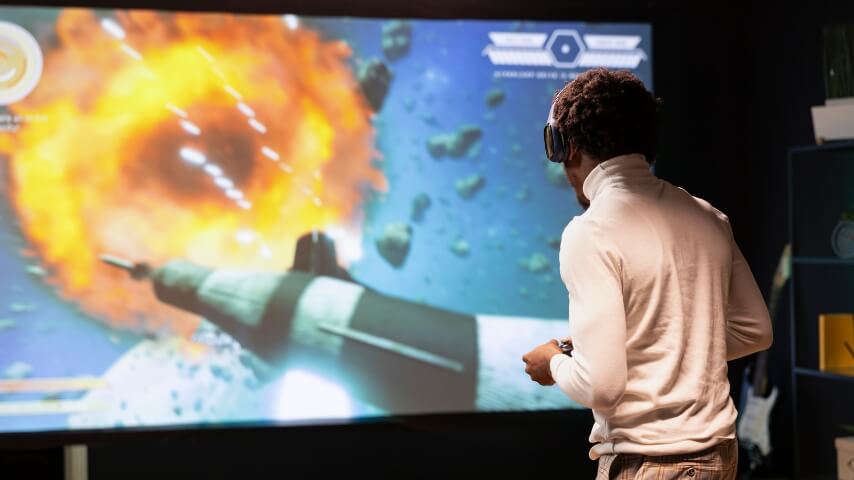
Want to level up your gaming experience without breaking the bank? Or looking for the latest solutions for an upscale gaming setup? Game projector screen paint is what you need.

It’s the ‘new tech’ in the gaming scene. And, many gamers are embracing it with gusto. Now, what makes them so special? And, why should you spend on some paint instead of the tried and tested traditional screens? Keep reading to learn more.

Playing Videogames on Game Projector Screen Paint

What are the benefits of using game projector screen paint for creating a game setup?

If you have been struggling with traditional screens, here are the top reasons why it’s time to upgrade.

  1. Cost-effective large display
  2. Projector screen paint allows you to create a large projection surface directly on your wall. Plus, it costs a fraction of a comparable high-quality projector screen. Creating a stunning 120″ screen with our projector screen paint costs just around £163-£188. Compare that to upwards of £800 for a decent ALR screen of the same size. This is ideal for gamers seeking an immersive experience without spending a hefty sum.

    [woo-slider sale_badge=”off” rating=”off” card=”3″ description=”off” check_stock=”off” on_sale=”off” cats=”17″ type=”” auto_paly=”on” theme=”1″]

  3. Works with PS5 and Xbox projectors
  4. Premium projector screen paints work seamlessly with every latest gaming console projector — 4K, 8K and Ultra HD. The best ones in the market are typically designed and tested with projectors from Epson, BenQ, Sony, Panasonic, and Optoma, ensuring perfect output. They are future-ready and can efficiently match the needs of more advanced projector technologies.

  5. Improved image quality in light
  6. Unlike traditional projector screens that show washed-out pictures in brighter rooms, specialised game projector screen paint delivers better picture quality even in rooms with ambient light. This makes it perfect for gaming during the day or night. Outdoor projector screen paint makes it possible to enjoy video games outdoors without compromising picture quality.

  7. Customisable screen size
  8. Projector screen paint offers unmatched flexibility in terms of screen size and shape. You are not limited to the pre-defined dimensions of traditional screens. It gives you complete freedom to design a projection surface that perfectly complements your space and gaming setup.

  9. Wider viewing angles for multiplayer gaming
  10. Premium video games projector screen paints provide a wide viewing angle. It enhances multiplayer gaming experience, as more people can see the screen from a wider angle without any drop in light reflection and image clarity. Smarter Surfaces projector paints support as wide as 140° viewing angle.

  11. Space-saving solution
  12. Gaming projector screen paint eliminates the need for bulky projector screens and additional accessories that occupy floor space. This makes it ideal for rooms with limited space. It can turn not only walls but almost any smooth surface into a screen, giving you unlimited options. They bring a clean, smart, and minimalist aesthetic to your gaming zone.

  13. Outdoor gaming setup
  14. Specialised gaming screen paints allow you to transform any surface, even the outdoor ones, into a high-end gaming screen. So, not only your living room but also your backyard or garden can turn into a perfect gaming space.

  15. Complete personalisation
  16. Want to transform your living room into a weekend gaming zone but don’t want to change the perfect wall colour? No worries. Smart clear projector screen paint will turn your wall into an effective gaming screen without changing the actual wall colour. It’s a simple way to personalise your gaming space the way you want.

  17. Multifunctional entertainment space
  18. Our game projector screen paint isn’t limited to video games. The same painted surface can be used for movie nights, presentations, or displaying other forms of visual content. This creates a versatile entertainment and workspace that can cater to a variety of needs.

  19. Simple installation
  20. Projector screen paint eliminates the need for complicated assembly associated with traditional projector screens. The paint can be applied directly to your wall using standard painting techniques, saving you time and effort. Plus, the paint kit comes with all the necessary accessories turning it into a simple DIY project. Check out installation videos in our video gallery.

  21. No set up hassle
  22. Have you been using a fabric screen that needs to be set up every time you want to dive into your favourite games? Keeping the screen wrinkle-free is another common struggle. Gaming projector screen paint turns almost any smooth surface into an always-ready gaming screen without any hassle of setting up.

  23. Minimal upkeep
  24. Paint, play, and forget. Top-of-the-shelf video games projector screen paints need minimal maintenance. The indoor varieties need only a good wipe down with a damp cloth while the outdoor paints may be washed with mild detergent once in a while. These are weather, UV, and crack-resistant. Plus, do not yellow over time.

Choosing the right game projector screen paint by Smarter Surfaces

Smarter Surfaces is a global leader in game projector screen paints. We manufacture a range of specialised projector paints to cater to personal and commercial needs.

For the best results, we suggest you choose a paint that matches your setup. Let’s take a look at some of our premium projector screen paints. This will help you choose the right product for your gaming space.

Outdoor Projector Screen Paint

An amazing option to maximise your outdoor space. Paint any outdoor wall and turn it into a giant gaming screen. The special layering formula works efficiently even on brighter days. Not only homes, they make a great choice to uplift any outdoor gaming environment, including cafes, restaurants, and commercial gaming spaces.

  • It is weatherproof. And has a certified gain value of 1.26 at 90 degrees.
  • Suitable for use on exterior surfaces — plaster, mortar, brick, stone, metal cladding, aluminium and composites.
  • White in colour, wipeable, and washable for easy maintenance. Comes with an 18-months guarantee.

Check out how popular gamer couple CamXPetra used our outdoor projector screen paint to magically transform any outdoor wall into a high-end gaming screen.

Smart Ultra High Contrast Projector Screen Paint

Designed for indoor gaming setups where higher contrast levels are desired. So if you’re looking for deeper blacks and vibrant colours this is the paint you need. Ultra high contrast projector screen paint works best in rooms with low ambient lighting.

  • High-quality, superior contrast and depth, with a certified 0.24 gain value at 90 degrees.
  • Suitable for use on different surfaces like plaster, wood, metal, wallboards, and composites.
  • Dark grey in colour and wipeable. Comes with a 5-year guarantee.

Ambient Light Rejecting Projector Screen Paint

No more compromising your indoor gaming experience due to unwanted light. This ambient light rejecting game projector screen paint scatters excess light hitting the screen from the sides, eliminating colour washout even in rooms with ambient light.

  • High-performance projection surface with a certified 0.60 gain value at 90 degrees.
  • Can be used on plaster, metal, wallboards, concrete, wood, and composite surfaces.
  • Light grey, wipeable surface. Comes with a 5-year product guarantee.

Clear Projector Screen Paint

Smart clear projector screen paint offers the same immersive experience without altering the aesthetics of the room. This transparent paint goes right on top of your existing wall paint and turns it into a screen but leaves the wall colour as is. Ideal for rooms with moderate to high ambient light.

  • Transparent projection screen paint. It has a certified gain value of 1.0 at 90 degrees.
  • Suitable for interior use on painted plaster, wallboards, wood, metal, concrete and composites
  • Wipeable and comes with a 5-year guarantee.

Here you can see how our various projection paints are suitable for gaming setups. You can choose a projection paint according to the lighting conditions.

Let’s sum it up
Game projector screen paints are an excellent alternative to traditional gaming screens and are quickly gaining popularity. They can turn any smooth surface, both indoors and outdoors, into an effective screen for all top-quality gaming projectors.

However, choosing the right gaming projector screen paint according to your setup can be tricky. If you want professional assistance to make the right choice, get in touch with our team of experts.

Smarter Surfaces
Privacy Overview

This website uses cookies so that we can provide you with the best user experience possible. Cookie information is stored in your browser and performs functions such as recognising you when you return to our website and helping our team to understand which sections of the website you find most interesting and useful.